
CAT6 vs. CAT6A vs. CAT5e: What’s Worth Paying For?
Once copper cabling has been identified as the appropriate medium for a network connection, the next design decision is determining the appropriate cable category: CAT5e, CAT6, or CAT6A.
Although these categories are often compared primarily by speed or bandwidth, selecting between them is a broader infrastructure decision.
Structured cabling is typically expected to remain in service far longer than many of the devices connected to it. Switches, wireless access points, cameras, phones, and other endpoints may be replaced several times while the cabling within walls, ceilings, pathways, and telecommunications spaces remains unchanged.
For that reason, cable selection should account for more than the immediate requirements of the network. It should consider the required data rate, link distance, application, installation environment, Power over Ethernet (PoE) requirements, physical pathway constraints, and the anticipated service life of the infrastructure.
Selecting a category that is insufficient for the intended application can restrict future network capabilities or lead to premature recabling.
At the same time, specifying a higher category does not automatically produce a better network. Higher-performance cabling can introduce additional material cost, larger cable diameters, tighter installation requirements, and greater pathway demands.
The objective is not to identify a universally “best” copper cable. It is to determine which category provides the appropriate performance, installation characteristics, and useful service life for the environment being designed.
In the previous article in this series, we examined where copper and fiber fit within structured cabling infrastructure. In many enterprise networks, fiber provides backbone and longer-distance connectivity, while copper provides the horizontal connection from the telecommunications space to devices such as workstations, wireless access points, cameras, phones, access-control systems, and other network endpoints.
This article focuses specifically on that copper infrastructure and examines how CAT5e, CAT6, and CAT6A differ, where those differences matter, and how to select the appropriate category for a given application.
Quick Comparison: CAT5e vs. CAT6 vs. CAT6A
Before getting into the design considerations, here is the basic planning picture.
| Category | Common Planning Role | Typical Capability | General Positioning |
| CAT5e | Legacy systems and modest endpoint requirements | Commonly associated with 1G connectivity | Still serviceable, but provides less long-term headroom |
| CAT6 | General-purpose modern commercial cabling | 1G over standard distances; 10G possible over shorter distances depending on the installation | Practical middle ground for many environments |
| CAT6A | Higher-performance and longer-life infrastructure | 10G across standard structured-cabling distances | Stronger fit where performance, density, or infrastructure lifespan justify it |
That table is useful, but it does not make the decision for you.
The important differences appear when the cable becomes part of a real building.
First: What Does a Cable Category Actually Mean?
CAT5e, CAT6, and CAT6A represent distinct performance categories within standards-based balanced twisted-pair copper cabling.
Each category defines a different level of electrical performance and is designed to support specific operating frequencies, data rates, and transmission requirements. As network demands increase, factors such as insertion loss, crosstalk, signal integrity, and installation quality become increasingly important to overall link performance.
However, cable category should not be evaluated in isolation.
The cable is only one component of the complete structured cabling channel.
A structured-cabling channel also depends on:
- installed horizontal cable
- connectors and jacks
- patch panels
- patch cords
- terminations
- cable routing
- pathway conditions
- installation workmanship
- testing and certification
That means specifying CAT6A cable does not automatically create a CAT6A-performing installation.
The complete channel has to be designed, installed, terminated, and tested accordingly.
That principle matters for every category discussed in this article.
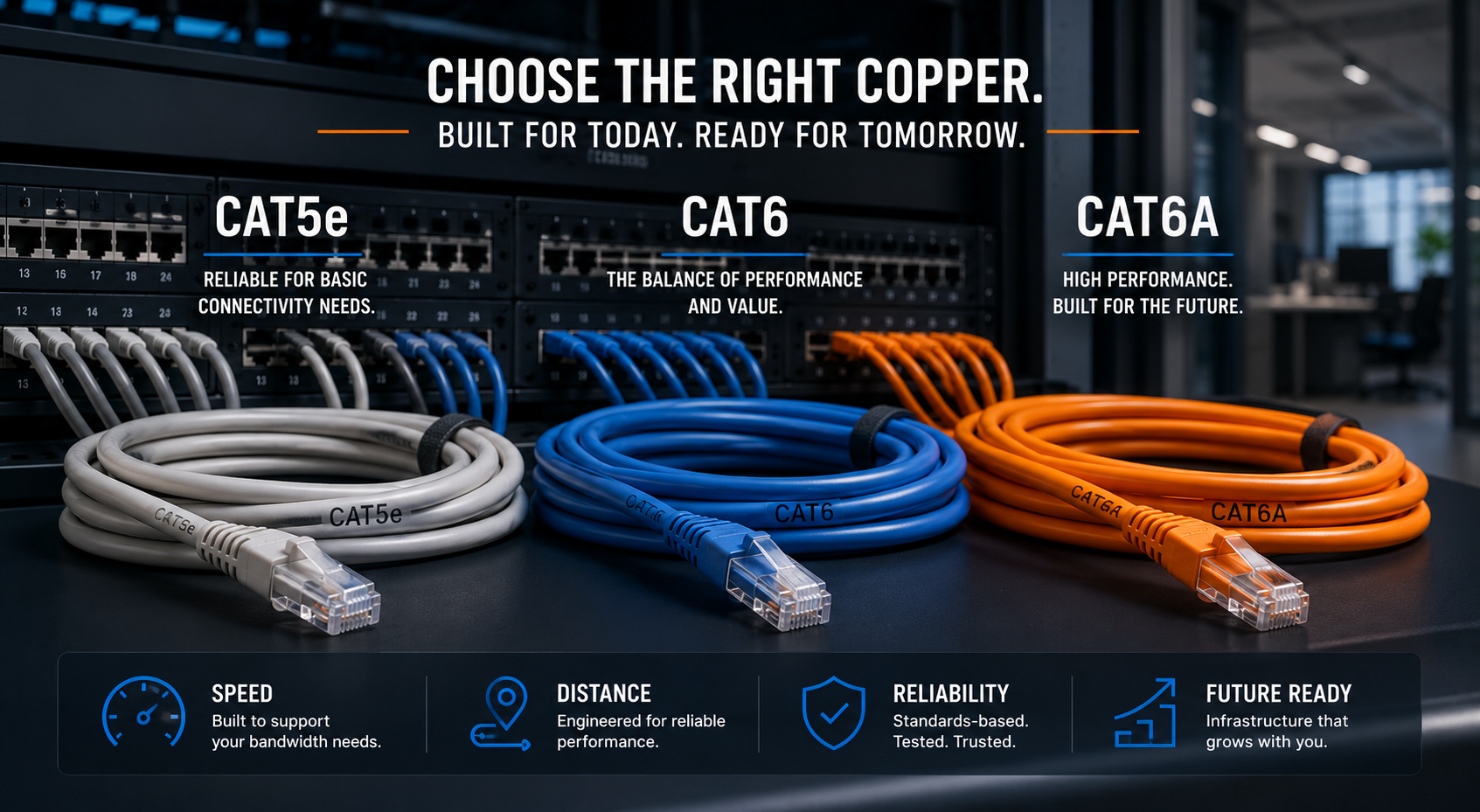
What Actually Changes the Decision?
Instead of asking whether CAT5e, CAT6, or CAT6A is universally better, it is more useful to evaluate the factors that make one category more appropriate than another.
1. Required Network Performance
The first consideration is the performance the cabling system is expected to support.
CAT5e remains widely associated with Gigabit Ethernet and continues to meet the requirements of many conventional endpoint applications.
CAT6 provides greater performance headroom and can support 10 Gigabit Ethernet over shorter distances, depending on channel length and installation conditions.
CAT6A is designed to support 10 Gigabit Ethernet across the full standard 100-meter structured-cabling channel, making it the more appropriate choice where sustained 10 GbE capability is a design requirement rather than a potential future use.
This distinction becomes increasingly important when the expected service life of the cabling exceeds that of the equipment connected to it. Workstations, wireless access points, cameras, switches, and other network devices may be replaced or upgraded several times while the horizontal cabling remains in place.
Category selection should consider both current application requirements and the level of performance the infrastructure is reasonably expected to support during its useful life.
2. Distance
Cable category does not remove the fundamental distance limitations of balanced twisted-pair Ethernet.
For standard Ethernet applications, structured copper cabling is generally designed around a maximum 100-meter channel, typically consisting of up to 90 meters of permanent horizontal cabling plus patch cords and other channel components.
Higher-category cabling can improve supported performance within that channel, but it does not allow copper to be extended indefinitely. Telecommunications-room placement, pathway design, and endpoint location therefore remain fundamental parts of the network architecture.
When a device cannot be served within the allowable copper distance, the appropriate response may not be to select a higher cable category.
The network architecture itself may need to change.
In larger facilities, this commonly means distributing network connectivity through additional IDFs and using fiber for backbone connections between telecommunications spaces, while copper serves the final horizontal connection to endpoints.
Distance planning and cable-category selection should therefore be treated as related design decisions rather than independent choices.
3. Power over Ethernet
Modern copper cabling frequently carries both data and electrical power.
Power over Ethernet is commonly used to support devices such as:
- wireless access points
- IP cameras
- VoIP phones
- access-control devices
- sensors
- building-automation equipment
- certain lighting systems
As the number and power requirements of connected devices increase, cabling design must account not only for data performance but also for power delivery.
Higher-power PoE applications, large cable bundles, and densely populated pathways can increase conductor temperature and place greater importance on bundle size, cable construction, pathway capacity, and installation practices.
This does not mean that every PoE application requires CAT6A. The appropriate category still depends on the application, required data rate, power level, installation environment, and expected growth.
PoE should be considered as part of the cabling-system design from the beginning rather than as an independent feature added after category selection.
A cabling plant serving a limited number of desk phones may face very different long-term requirements from one supporting dense wireless deployments, extensive camera coverage, access-control systems, and building automation.
4. Installation Conditions
A higher cable category can provide greater electrical performance, but it may also introduce additional physical and installation requirements.
Compared with lower-category cabling, CAT6A installations may involve:
- larger cable diameters
- reduced cable flexibility
- greater pathway and conduit-space requirements
- larger bend-radius considerations
- increased cable-management requirements
- category-compatible jacks, patch panels, and patch cords
- additional installation and termination effort
These characteristics can materially affect pathway capacity, rack and cabinet design, cable routing, labor requirements, and overall project cost.
The performance of a structured cabling system also depends on installation quality. A higher-performing cable does not compensate for excessive bending, compression, poor termination, inadequate pathway capacity, or other installation practices that compromise the channel.
The physical environment and installation requirements should be considered during category selection, not after the cable has already been specified.
5. Infrastructure Lifespan
Structured cabling is typically expected to remain in service longer than the active electronics connected to it.
Switches, access points, cameras, computers, and other network devices may be refreshed as technology and operational requirements change. Replacing the cabling concealed throughout walls, ceilings, pathways, and telecommunications spaces is generally more disruptive and labor-intensive.
For that reason, the anticipated service life of the infrastructure is an important part of category selection.
If an organization expects to occupy a facility for many years, increase device density, deploy higher-performance wireless infrastructure, expand surveillance or access-control systems, or introduce additional connected-building technologies, additional cabling performance headroom may provide meaningful long-term value.
In a temporary, lightly used, or highly cost-sensitive environment with limited anticipated growth, the same level of investment may not be justified.
The objective is not to design around every technology that might appear in the future. It is to select infrastructure that can reasonably support the organization’s expected requirements without becoming an avoidable constraint well before the end of its intended service life.
Where Each Category Fits
With those design factors established, the differences between CAT5e, CAT6, and CAT6A become easier to interpret.
CAT5e: Capable, but Increasingly Situational
CAT5e has supported commercial networks for many years and remains present throughout existing offices, schools, commercial spaces, and legacy network environments.
It is commonly associated with applications such as:
- 1 Gigabit Ethernet
- standard workstations
- desk phones
- printers
- basic IP devices
- existing legacy networks
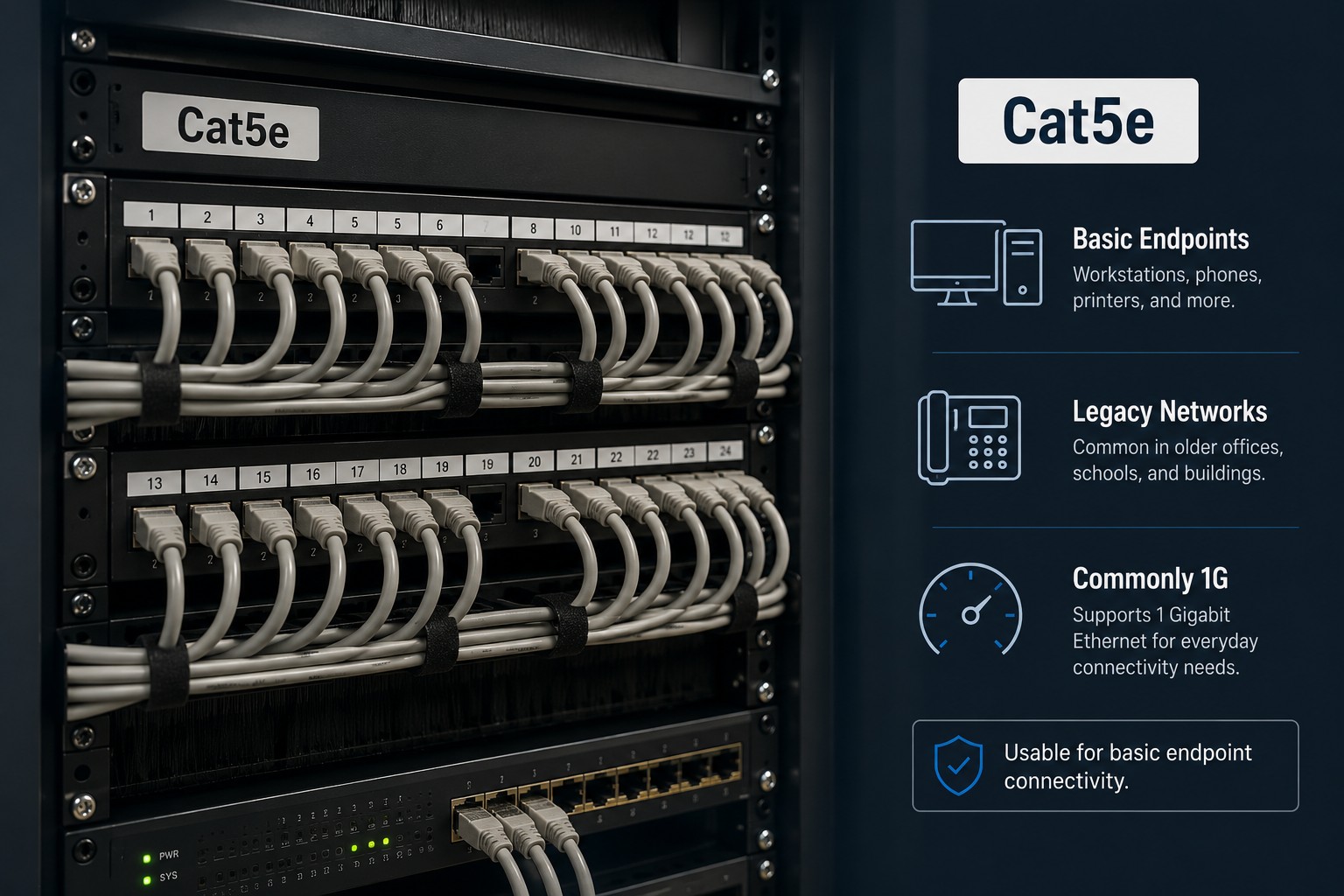
The important distinction is between existing CAT5e infrastructure and specifying CAT5e for a new installation. Existing CAT5e that continues to meet the application's performance requirements does not need to be replaced simply because newer categories are available. For new installations, however, the decision should consider whether CAT5e provides sufficient performance headroom and useful service life for the organization’s expected requirements.
CAT5e may still be reasonable for:
- highly budget-constrained projects
- temporary facilities
- modest endpoint requirements
- small additions to an existing CAT5e system
- environments with limited growth expectations
Its limitation is not that it suddenly stops working, but that the performance and cost savings it offers today may become a constraint as network requirements increase.
CAT6: The Practical Middle Ground
CAT6 remains a common choice for general-purpose commercial copper cabling because it balances performance, cost, physical installation requirements, and broad endpoint compatibility.
Typical applications include:
- workstations
- VoIP phones
- printers
- wireless access points
- IP cameras
- conference-room systems
- access-control devices
- general business connectivity
For many office and commercial applications, CAT6 provides a strong modern foundation without necessarily introducing the additional material and installation requirements associated with CAT6A.
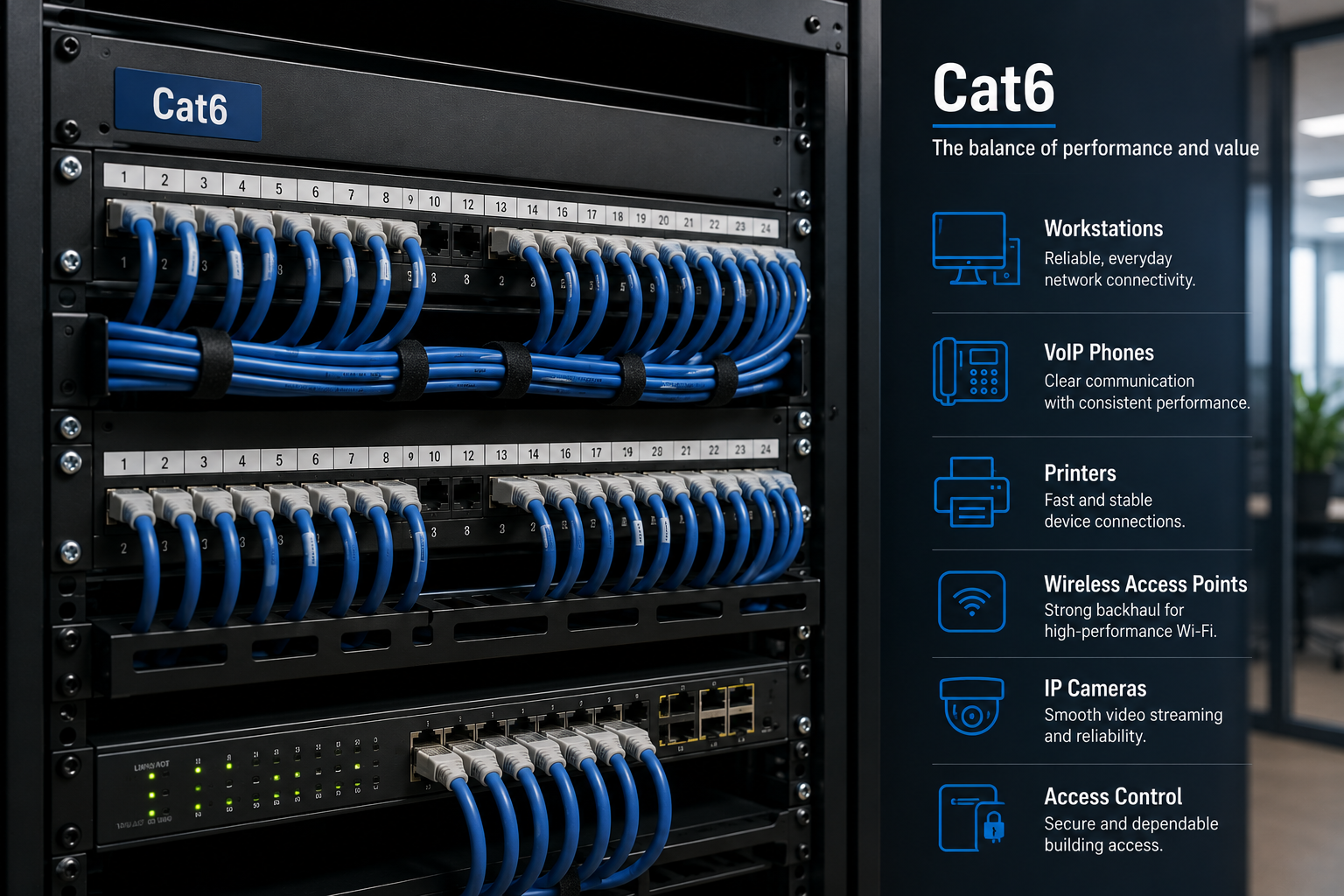
That makes it especially relevant when the network needs more capability than an older CAT5e design but does not have a clear requirement for 10G across full copper-channel distances. CAT6 should therefore be viewed neither as the minimum acceptable option nor as a compromise.
In the right environment, it is simply the correct design choice.
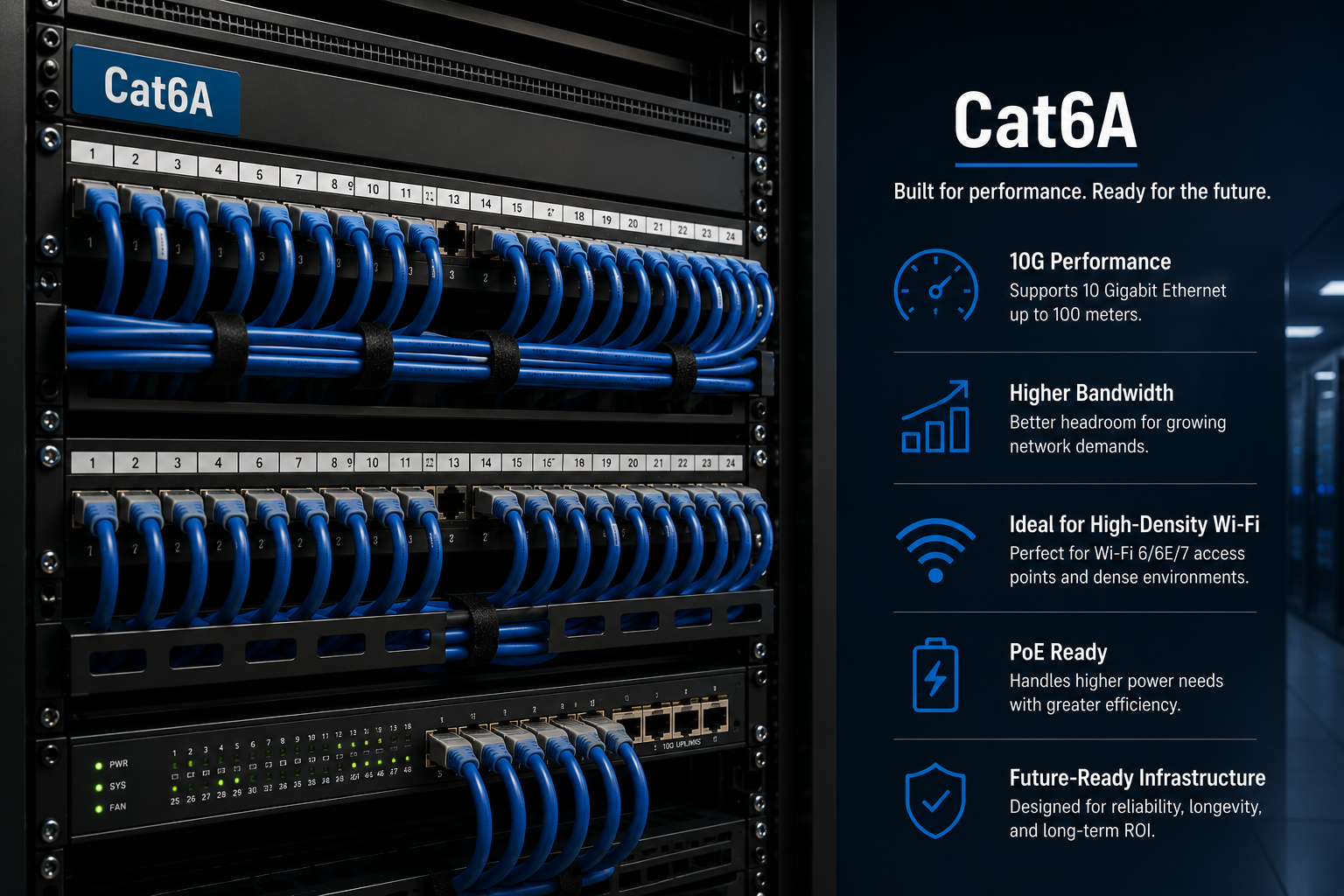
CAT6A: More Headroom Where the Project Can Use It
CAT6A becomes more compelling when the infrastructure has greater long-term responsibility.
It is commonly considered where the design calls for:
- 10G across standard structured-cabling distances
- long infrastructure lifespan
- higher-performance wireless networks
- dense device environments
- increasing PoE demand
- environments where future recabling would be difficult or disruptive
CAT6A is particularly relevant in newer enterprise facilities, healthcare environments, educational campuses, large office deployments, high-performance wireless networks, and other installations expected to support evolving technology requirements over a long service life.
However, CAT6A should not be treated as an automatic upgrade over CAT6. Its higher performance can come with increased material cost, larger cable diameters, greater pathway-space requirements, reduced installation flexibility, and more demanding cable-management and hardware considerations.
Those tradeoffs are appropriate when the project benefits from the additional performance and lifecycle headroom. Where those advantages are unlikely to be used, specifying CAT6A throughout the facility can add cost and complexity without delivering proportional value.
The Cost Question: Cable Price Is Only Part of the Equation
Comparing CAT5e, CAT6, and CAT6A only by the price of the cable reel misses most of the actual project cost.
A more complete comparison includes:
- cable material
- connectors and termination hardware
- installation labor
- pathway capacity
- cable management
- patch panels
- testing and certification
- future replacement
- downtime
- disruption caused by recabling
Cable selection should also be evaluated in terms of lifecycle value rather than initial material cost alone. A lower-cost category can become the more expensive option if it requires premature replacement, while a higher-cost category may offer poor value if its additional capability is unlikely to be used during the expected life of the infrastructure.
So instead of asking:
“Which cable is cheapest?”
the more useful design question is:
“Which cable provides the best value over the expected life of this infrastructure?”
This approach keeps category selection aligned with the expected performance, service life, and total cost of the cabling infrastructure.
How the Environment Changes the Answer
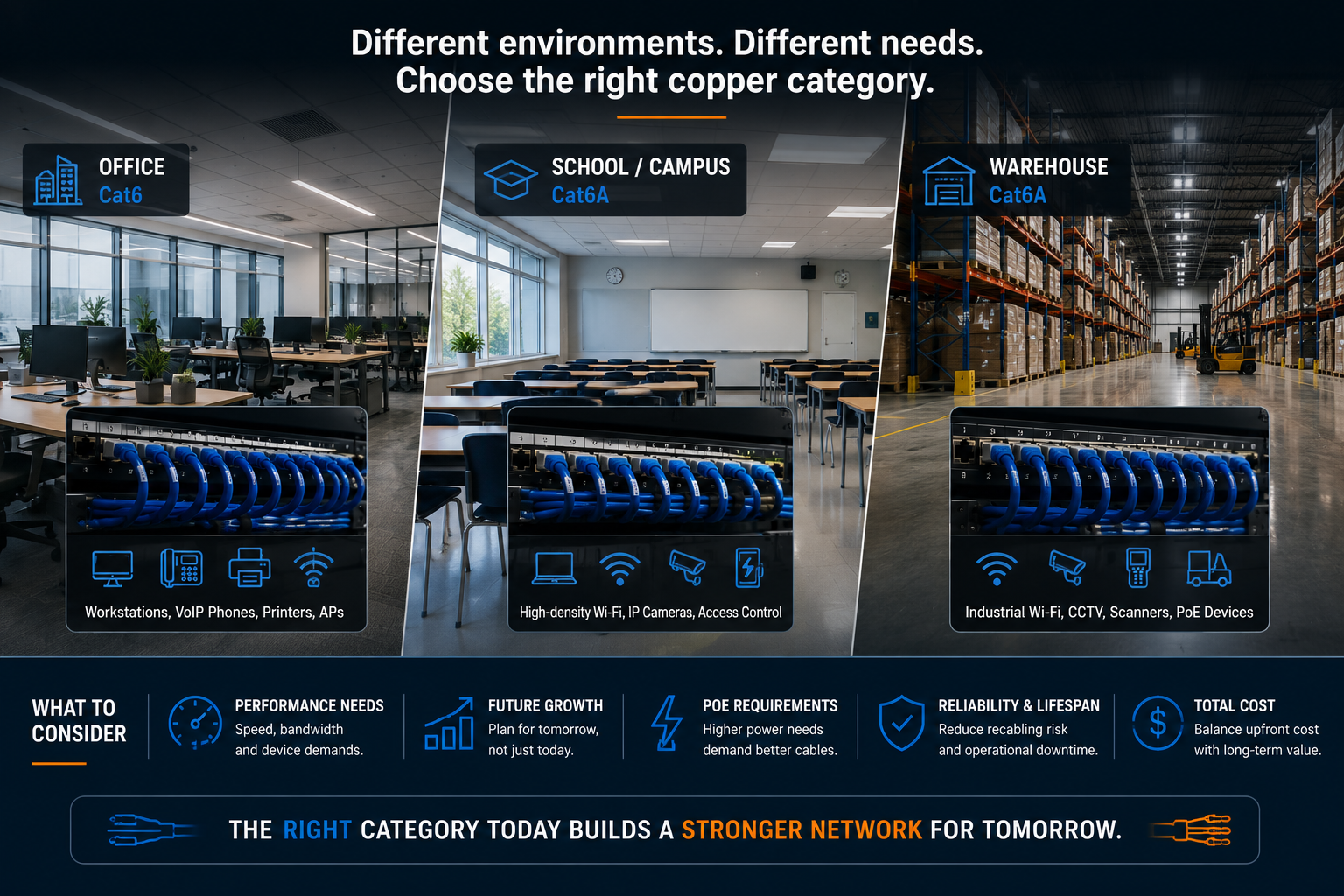
There is no universal category that belongs in every building. The environment changes the priorities.
Small Office
A small office with modest endpoint demand and limited growth may be well served by CAT6.
CAT5e may still make sense in highly constrained or legacy-aligned situations, but CAT6 generally provides a more flexible starting point for new commercial installations.
Growing Office
A growing office should consider not only current employee count but also:
- additional wireless access points
- increasing device density
- longer occupancy
- collaboration systems
- cameras and security devices
- future bandwidth requirements
CAT6 may remain sufficient. CAT6A becomes more attractive when the expected growth begins to justify the additional headroom.
Warehouse
Warehouses introduce a broader infrastructure-design challenge because office areas, wireless access points, cameras, operational devices, long cable runs, and distributed telecommunications spaces may all exist within the same facility.
In these environments, CAT6 or CAT6A may be appropriate for horizontal connections to endpoints, while fiber is often used between network rooms where distance, bandwidth, or backbone requirements make copper less suitable.
The resulting design is therefore often a combination of cable categories and media, selected according to the role each segment must perform rather than a single cable type applied throughout the entire building.
Healthcare and Education
Facilities such as hospitals, clinics, schools, and campuses may place greater emphasis on infrastructure lifespan, reliability, device growth, and the disruption associated with future recabling.
In those environments, the longer-term value of CAT6A can become easier to justify.
Data-Heavy or High-Demand Environments
Organizations expecting dense wireless infrastructure, high device counts, substantial traffic growth, or long service life should give greater weight to performance headroom and the cost of future replacement.
Again, that does not automatically dictate CAT6A.
It changes the economics of the decision.
Common Mistakes When Choosing a Cable Category
Mistake 1: Choosing CAT5e Only Because It Costs Less
Lower initial cost does not necessarily mean lower lifecycle cost.
If the cable becomes a limitation earlier than expected, the savings can disappear quickly.
Mistake 2: Choosing CAT6A Everywhere “Just in Case”
Higher specification is not the same as better design.
If the network has no realistic use for the additional capability, the project may simply be paying for unused headroom and greater installation complexity.
Mistake 3: Ignoring Wireless Infrastructure
Wireless networks still depend on wired infrastructure.
As access points become more capable and network demand increases, the cabling serving those APs becomes part of the performance equation.
Mistake 4: Designing Only for Today's Devices
The device connected to a cable today may not be the device connected to it five or ten years from now.
Cabling lifespan should therefore be considered separately from endpoint lifespan.
Mistake 5: Treating the Cable Reel as the Entire System
Category performance depends on the installed channel.
Cable, connectors, patch panels, patch cords, terminations, pathways, workmanship, and testing all matter.
The Future-Proofing Trap
“Future-proofing” is a useful design objective when it is grounded in realistic expectations for how the facility and network are likely to evolve.
Good future planning considers likely growth. It asks:
- How long will the organization occupy the facility?
- Is wireless density likely to increase?
- Are additional cameras or smart-building devices expected?
- Is a network refresh already planned?
- Would future recabling be disruptive or expensive?
- Is greater performance headroom likely to be used?
The problem arises when future-proofing becomes a reason to specify more infrastructure than the project is likely to need.
“Install the highest category everywhere so we never have to think about it again.”
That approach does not necessarily produce a better long-term design. Selecting the highest available category can add cost, pathway demand, installation complexity, and hardware requirements without providing corresponding value if the additional capability is never used.
A more effective approach is to match the level of investment to the facility’s expected operational growth, performance requirements, and anticipated service life.
For some projects, that balance may favor CAT6. For others, CAT6A may be the more appropriate long-term choice. In existing environments, CAT5e may also remain fully suitable where it continues to meet the required performance.
A Simple Decision Framework
If you are evaluating a new copper-cabling project, start with these questions:
- What performance does the network actually require?
- How long is the cabling expected to remain in service?
- What devices will it support now and later?
- How much PoE demand is expected?
- How difficult would future recabling be?
- What are the pathway and installation constraints?
- Does the additional capability of a higher category solve a real problem?
Those questions usually tell you far more than asking which category is “best.”
What We Covered
CAT5e, CAT6, and CAT6A should not be viewed simply as progressively better versions of the same cabling.
Each category represents a different balance of performance capability, installation requirements, cost, and expected service life.
The appropriate choice depends on how those characteristics align with the network’s current requirements, the physical environment, and the organization’s realistic expectations for future growth.
Initial cable cost is only one part of the infrastructure decision. A lower-cost option can provide poor long-term value if it becomes a constraint too early, while a higher-performing category may add unnecessary cost and complexity if its additional capability is unlikely to be used.
The strongest design is not the one that specifies the highest category by default, but the one that selects cabling appropriate to the application, environment, and intended lifecycle of the infrastructure.
Cable category, however, is only one part of the copper-cabling decision.
The surrounding environment can introduce another set of design considerations, including electromagnetic interference, pathway conditions, grounding and bonding requirements, cable construction, and whether a shielded or unshielded system is appropriate. We will explore more on this in the articles that follow.
OrionUS helps organizations evaluate copper-cabling requirements in the context of the facility, the network, and the applications the infrastructure is expected to support. That evaluation can include current performance requirements, anticipated device growth, wireless infrastructure, PoE demand, building layout, installation constraints, and long-term infrastructure planning.
The objective is to develop a cabling system that provides the appropriate performance, capacity, installation characteristics, and service life for the way the facility is expected to operate.
Continue Reading in This Series
Next article:
Shielded vs. Unshielded Ethernet Cabling — When Does the Environment Change the Design?
Cable category is only one part of performance. This article explains when unshielded cabling is enough, when shielded cabling becomes necessary, and how EMI and environment affect structured cabling decisions.
Industry News

Wi-Fi is often discussed in terms of coverage: how far an access point reaches, whether a signal is strong enough, or whether another access point is needed. But before coverage...

Wi-Fi feels simple because most of its complexity is invisible. An access point is installed, a laptop, phone, scanner, or handheld connects, and data starts moving. But between...
Most people only see the final result of a wireless deployment: access points mounted on ceilings, devices connected to Wi-Fi, and users moving throughout a facility with reliable...
Modern networks are built on a combination of structured cabling, fiber optics, wireless infrastructure, security systems, and connected technologies that support daily business...
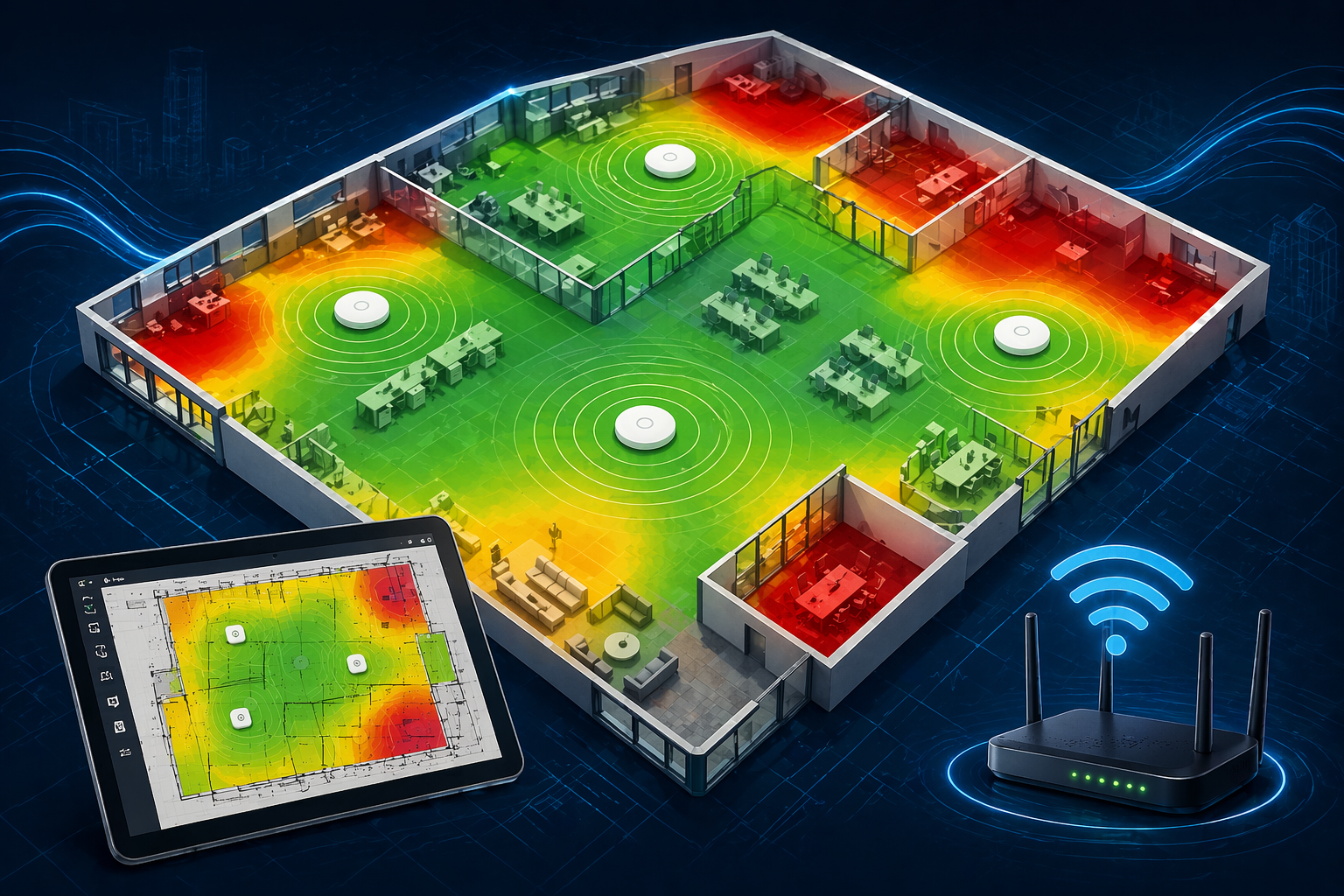
Wi-Fi performance issues rarely originate after deployment. In most cases, they are introduced much earlier during the planning and design phase. Dead zones, weak signal areas,...
When planning a wireless network, many organizations start with a predictive survey. This approach uses digital floor plans and wireless design software to simulate how Wi-Fi...

