



In practice, factors such as wall materials, metal structures, interference from other wireless devices, furniture placement, and user density can significantly impact wireless performance. These variables are difficult for predictive models to fully account for, which can lead to coverage gaps or inconsistent performance after deployment. For this reason, modern wireless design works best when predictive planning is validated through APOS (AP-on-a-Stick) on-site surveys. By temporarily placing real access points at proposed locations and measuring actual signal behavior in the environment, engineers can confirm the design, adjust placements, and ensure the final network delivers the reliability and coverage businesses expect.
1. What Is a Predictive Wireless Survey?
.png?width=1536&height=1024&name=1f3e66a3-af07-4169-942d-86dcc787a75a%20(1).png)
A predictive wireless survey is a planning method that uses digital building floor plans and specialized wireless design software—such as Ekahau—to simulate how Wi-Fi signals will propagate throughout a building before any hardware is installed.
Wireless engineers input details about the building structure, including walls, floors, and materials, along with the desired wireless performance targets. The software then models how radio frequency (RF) signals will travel within that environment and recommends optimal access point placement.
Predictive surveys help organizations:
-
Design wireless networks quickly without visiting the site
-
Estimate the number of access points required for coverage
-
Forecast equipment costs and installation budgets
-
Identify potential coverage gaps early in the design process
-
Prepare network proposals for stakeholders or clients
Because predictive surveys are software-based, they allow teams to evaluate multiple design scenarios quickly. This makes them particularly useful during the early planning phase of large wireless projects or when designing networks across multiple locations.
However, predictive models rely on assumptions. Even when accurate floor plans are available, they cannot fully account for many real-world variables.
For example, predictive tools may not detect:
-
Hidden structural materials inside walls
-
Signal reflections caused by metal shelving or machinery
-
RF interference from neighboring networks or devices
-
Furniture placement and human occupancy patterns
-
High device density in busy environments
Predictive surveys show what should happen, not what actually will happen. They provide an excellent starting point for wireless design—but they do not replace real-world testing.
2. What Is an APOS On-Site Wireless Survey?
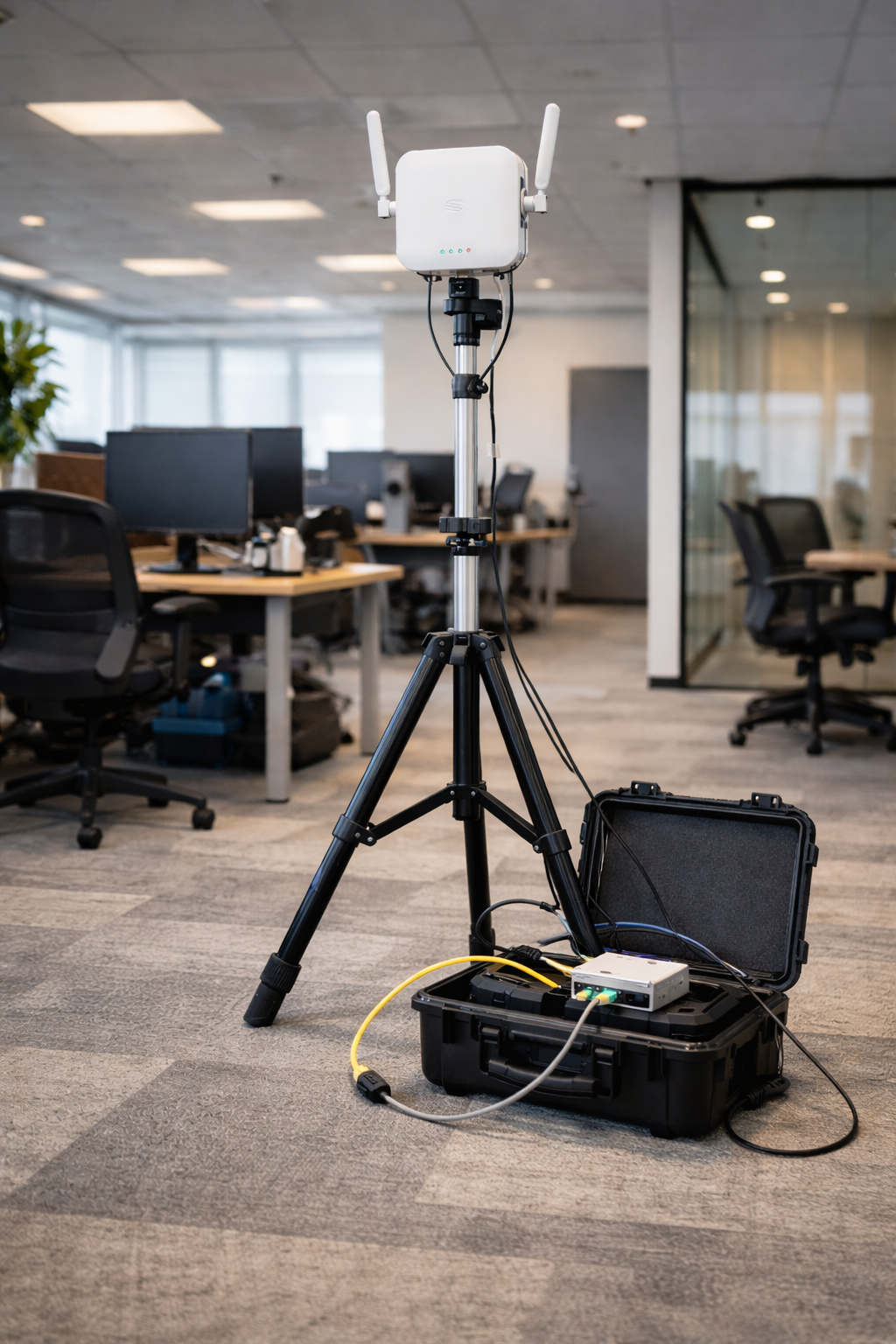
An APOS (AP-on-a-Stick) wireless survey involves placing a real access point temporarily at the locations recommended during the predictive design phase. Engineers then measure actual wireless performance throughout the space using professional survey tools.
Unlike predictive modeling, APOS surveys measure how Wi-Fi behaves in the real environment. This includes the impact of building materials, physical obstacles, RF interference, and device density.
During an APOS survey, engineers typically move through the facility collecting signal data, testing roaming behavior, and validating performance requirements.
APOS surveys provide insight into:
-
True signal strength and coverage patterns
-
Actual overlap between neighboring access points
-
Sources of interference from other wireless networks or devices
-
Roaming performance for mobile devices
-
Network capacity in high-density areas
A predictive survey might suggest that five access points will cover a warehouse. But an APOS survey may reveal that large metal racks reflect signals in unexpected ways, requiring additional access points or adjusted placement.
Instead of relying on assumptions, APOS testing validates the design before deployment. A simple way to think about the relationship between the two methods is:
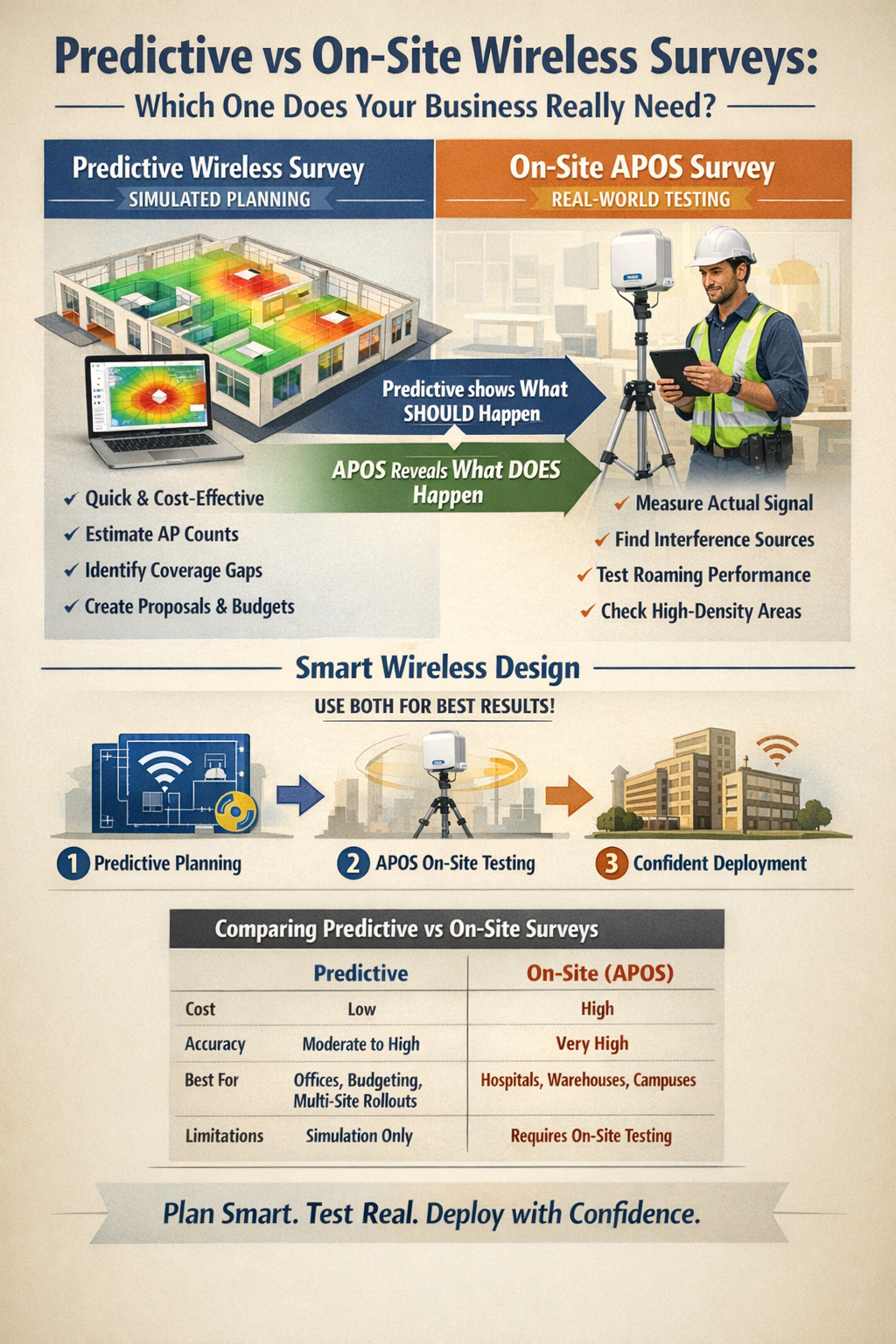
Predictive surveys suggest where access points should go. APOS surveys confirm that the design actually works.
3. Why Smart Businesses Use Both
The most successful wireless deployments rarely rely on a single design method. Instead, experienced network engineers combine predictive modeling with on-site validation to ensure optimal results.
The typical workflow looks like this:
-
Predictive survey to design the network layout
-
APOS on-site survey to validate coverage and performance
-
Deployment with confidence based on real-world measurements
This hybrid approach provides several advantages. First, predictive surveys allow engineers to design networks quickly and cost-effectively before visiting the site. This accelerates planning and helps organizations estimate budgets early in the project.
Second, APOS validation ensures that the design performs as expected in the real environment. Any coverage gaps, interference issues, or roaming problems can be corrected before full installation begins.
By combining both methods, organizations can:
-
Reduce costly redesigns after deployment
-
Speed up network rollout timelines
-
Improve wireless reliability from day one
-
Optimize access point placement and performance
-
Lower long-term maintenance costs
In short, predictive surveys create the blueprint, while APOS testing ensures the blueprint works in practice.
4. When APOS Surveys Are Essential
While predictive surveys are useful in many scenarios, there are situations where on-site validation becomes critical.
Organizations should strongly consider APOS surveys when wireless performance directly impacts operations or safety.
For example, APOS validation is essential when:
-
Wi-Fi downtime impacts business operations
-
Large number of users or devices share the network
-
Facilities include complex layouts or large open spaces
- Seamless roaming between access points is necessary
In these environments, wireless failures can disrupt workflows, delay operations, or even impact safety
5. Comparing Predictive, On-Site Wi-Fi Surveys
Below is a simplified comparison between predictive and on-site wireless surveys
|
Survey Type |
Cost Level |
Accuracy |
Best For |
Limitations |
|
Predictive |
Low |
Moderate to High (when inputs are reliable) |
Modern offices, early-stage planning, multi-site rollouts, and budgeting |
Cannot detect live interference, user density issues, or undocumented structural changes |
|
On-Site (APOS) |
High |
Very High |
Warehouses, hospitals, campuses, schools, legacy buildings, and high-risk environments |
Requires engineer time, travel, and physical access to the site |
Predictive surveys are excellent for planning, while APOS surveys are critical for validation. Organizations that combine both approaches achieve the most reliable wireless networks.
6. Conclusion
Predictive wireless surveys help organizations plan their network design quickly and efficiently. They provide valuable insight into access point placement, expected coverage, and overall network architecture. However, predictive models alone cannot guarantee real-world performance.
APOS on-site surveys bridge this gap by measuring actual signal behavior in the physical environment. They confirm coverage, detect interference, and ensure the network meets operational requirements before installation.
For organizations where wireless connectivity truly matters, the best strategy is not choosing between predictive and on-site surveys. The best strategy is using both. When both approaches are used together, businesses gain the confidence that their Wi-Fi infrastructure will deliver consistent coverage, strong performance, and long-term scalability.
If your organization is planning a new wireless deployment or experiencing performance challenges, the team at Orion US can help. With extensive experience in wireless surveys, network design, and installation, our engineers deliver solutions tailored to your environment and operational needs. Contact Orion US today to schedule a consultation and ensure your wireless network is built for reliability from day one.
Predictive surveys help you plan. APOS surveys help you get it right.
Please get in touch with the experts at Orion US today.

Image Source: Canva