
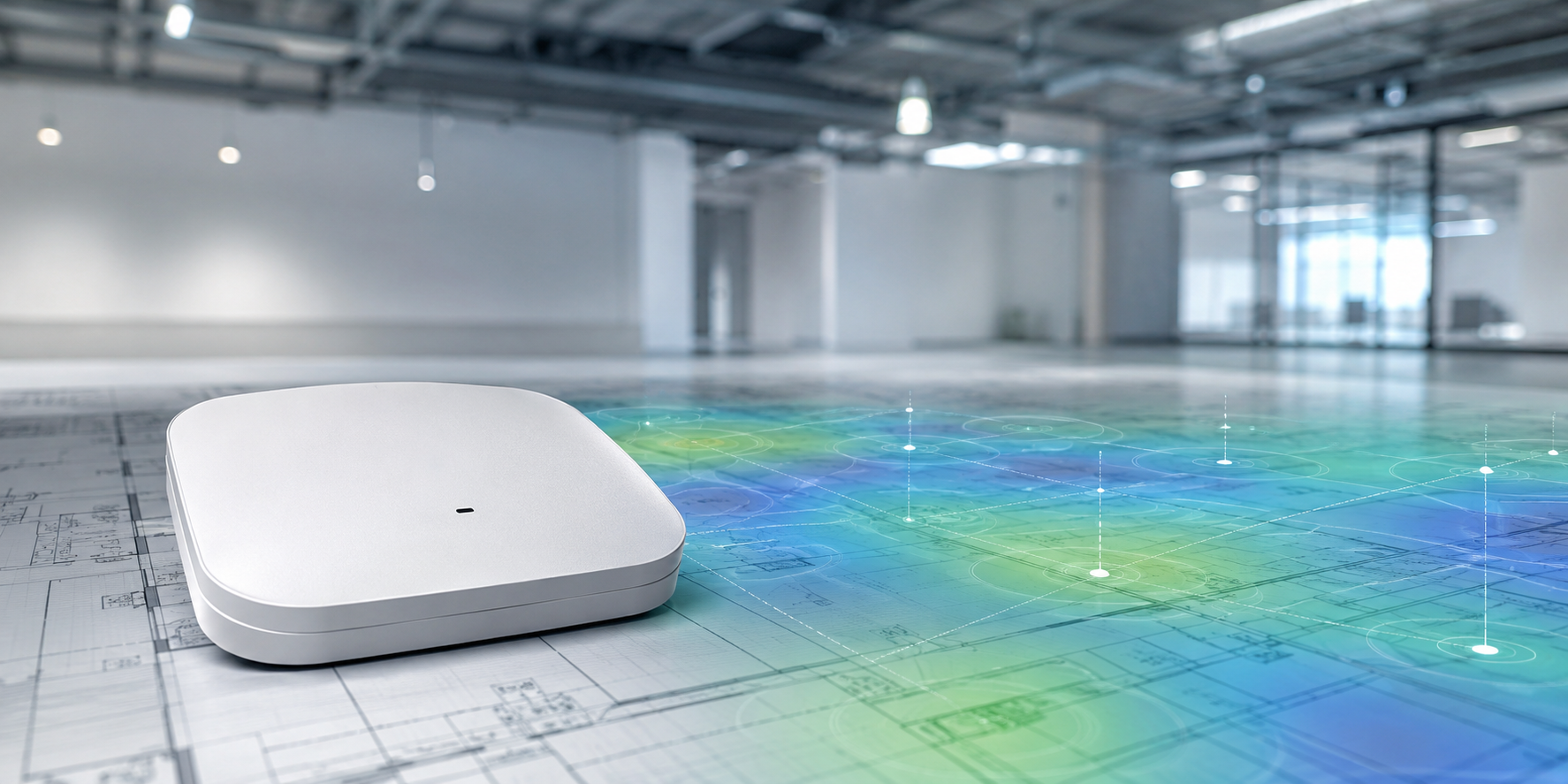
Most people only see the final result of a wireless deployment: access points mounted on ceilings, devices connected to Wi-Fi, and users moving throughout a facility with reliable connectivity. What often goes unseen is the planning, analysis, and validation that take place long before the first access point is installed.
Successful wireless networks are not created by simply placing access points throughout a facility. Reliable performance depends on understanding requirements, modeling RF behavior, validating assumptions, and verifying results after deployment.
Whether supporting an office, warehouse, manufacturing facility, healthcare environment, or distribution center, the design process begins well before installation. Understanding how the environment will be used, how RF signals are expected to behave, and how users and devices will rely on the network is critical to achieving a successful outcome.
Successful Wi-Fi deployments are designed long before they are installed.
1. Defining Coverage and RF Performance Requirements
Every wireless deployment begins with a simple question:
What is the network expected to support?
While coverage is often the first requirement discussed, it is rarely the only consideration. Different environments have different operational needs, and those needs directly influence how a wireless network should be designed.
A successful wireless network is not defined solely by coverage. Signal quality, capacity assumptions, coverage overlap, and application-support requirements all play an important role in shaping the wireless design.
Factors commonly considered include:
- Coverage requirements
- User and device density
- Device types
- RF Performance targets
- Coverage Overlap
- Future growth plans
For example, a warehouse supporting handheld scanners and mobile operators may have very different requirements than a corporate office supporting laptops, video conferencing, and collaboration platforms.
Defining these expectations early helps establish the foundation for the design process and ensures that the wireless network aligns with the facility's operational needs.
2. Understanding the Physical Environment
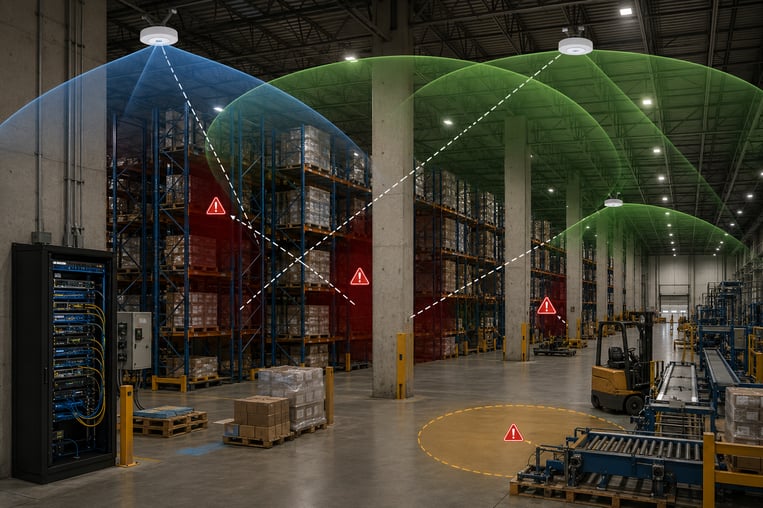
Once requirements are established, attention shifts to the environment itself. Wireless signals do not travel through every building the same way. Building materials, ceiling heights, room layouts, equipment, and physical obstructions can all influence network performance.
A wireless design may need to account for:
- Interior walls and partitions
- Concrete or masonry construction
- Metal shelving and racking
- Mechanical equipment
- Open office layouts
- High-veiling warehouse spaces
- Production areas and storage zones
In many environments, the physical characteristics of the facility have a greater impact on wireless performance than the access points themselves.
Understanding these conditions helps ensure that the design reflects real-world operating conditions rather than assumptions.
3. Predictive Wireless Design
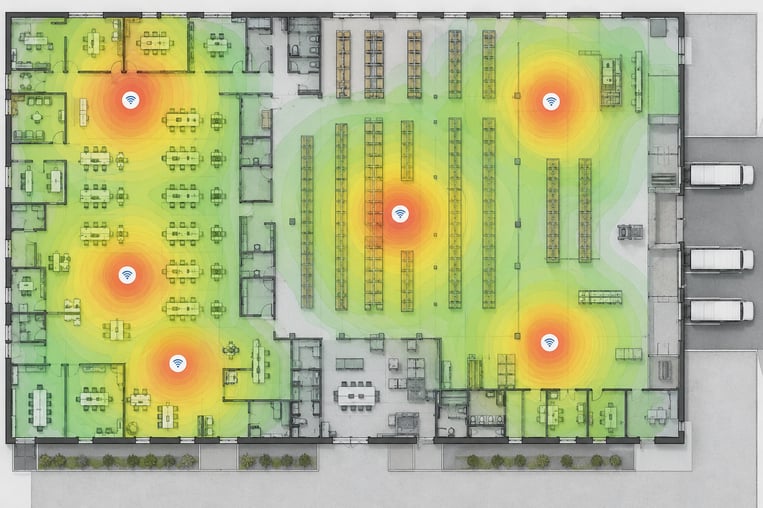
With requirements and facility information in hand, the design process can begin. Predictive wireless design uses digital floorplans and modeling software to simulate how wireless signals are expected to behave within the environment. This allows designers to evaluate coverage, identify potential problem areas, and determine preliminary access point locations before any hardware is installed.
A predictive design can help answer questions such as:
- How many access points may be required?
- Where should access points be located?
- Are there areas likely to experience weak coverage?
- How will building materials affect signal propagation?
- Are capacity and airtime assumptions being addressed?
By identifying potential issues early, predictive modeling helps reduce risk and provides a more informed starting point for deployment planning.
4. Validating the Design
While predictive modeling is an important step, real-world environments do not always behave exactly as simulations predict. This is where validation becomes critical.
One common validation method is AP-on-a-Stick (APOS) testing, where temporary access points are positioned within the facility to verify expected RF coverage and signal behavior before permanent installation begins.
Validation testing helps confirm:
- Coverage expectations
- Signal strength targets
- Access point placement strategies
- Environmental influences
- Potential design adjustments
This step provides an opportunity to refine the design before installation, helping reduce costly changes later in the project.
5. Deployment and Post-Installation Validation
By the time installation begins, much of the most important work has already been completed. Access point locations have been planned, design assumptions have been validated, and deployment teams have a clear understanding of the intended network architecture and physical installation requirements.
Following installation, additional RF validation may be performed to verify that the deployed environment aligns with design expectations.
This final phase may include:
- Coverage validation
- Signal strength and signal-quality review
- Access point placement validation
- Predicted vs actual RF performance comparison
- RF-based channel and power adjustment recommendations
- Documentation updates

Wireless Success Starts Before Deployment
Reliable Wi-Fi is rarely the result of access point placement alone. Successful wireless deployments are built through a structured process that combines planning, environmental analysis, predictive modeling, validation, installation, and post-deployment RF review. Each phase contributes valuable information that helps reduce risk, improve performance, and support long-term operational requirements.
By investing time in design before installation begins, organizations can create wireless networks that better support users, devices, applications, and future growth while avoiding many of the challenges associated with reactive deployments.
The result is a wireless network designed around operational requirements, user behavior, and real-world RF conditions, not simply a floorplan.
At Orion US, wireless projects begin long before hardware arrives on-site. Through predictive design, site validation, installation planning, and post-deployment RF validation, we help organizations build wireless environments that are designed to perform from day one.
Please get in touch with the experts at Orion US today.
Image Source: Canva